

Quality
QUALITYContact Us
CONTACT USZHUHAI KAMEDA TECHNOLOGY CO., LTD.
Tel: +86 756 516 6177
Email: Show contact details
Add: 4/F, Block 4, No.26 XinKe 2nd Rd, Baijiao Science & Technology Industrial Park, Doumen District, Zhuhai, Guangdong, China 519100
+86 756 516 6177
Laboratories
Five labs sit alongside the production floor: AI and machine vision, industrial robotics, electronics and instrumentation, audio and acoustics, and reliability and test. Between them they cover algorithm validation, mechanism trials, electrical measurement, acoustic performance and life testing. They are used at prototype stage, where a design problem can still be fixed for the cost of a revision.
The labs work directly with engineering, process and quality. Findings from the validation stage go into the DFM, DFT and DFR review as written comments, and from there into stencil apertures, test point placement, fixture design and inspection specifications that the production floor actually runs to.
AI and machine vision lab
Used for front-end validation of vision systems: camera selection, lens and working distance, lighting type and angle, calibration, and algorithm tuning. If a project needs surface inspection, locate-and-pick, code reading or counting, we can run sample images in the lab first and report detection rate and false-reject rate before deciding where the camera goes on the line. That way the vision approach is proven before any fixture is machined.
Industrial robotics lab
More than 100 industrial robots are in operation across the plant. The lab handles work cell design before anything is installed on the floor: robot model and reach, cycle time calculation, path and interference checking, end effector and fixture design, and trial runs of the dispensing, screw driving and pick-and-place steps. A cell is proven here and then replicated on the line, which keeps commissioning downtime short.
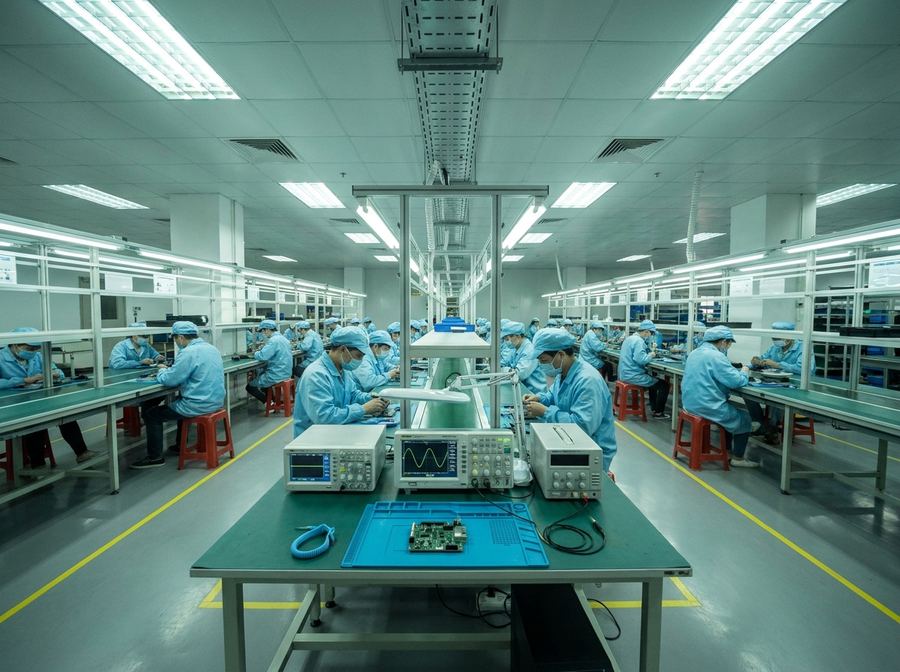
Electronics and instrumentation lab
Power supplies, oscilloscopes, signal generators and multimeters for validating schematics and PCB layout: bring-up, waveform and timing checks, current and power measurement, communication interface debugging, and first-pass verification of firmware and SDK. Design problems found on a prototype can be corrected together with mechanical and process changes in the same revision, before tooling and volume material are committed.
Audio and acoustics lab
For tuning and measuring speakers, microphones and finished-product acoustic performance: frequency response, sensitivity, distortion and rattle or buzz. It also covers what the mechanical design does to the sound, including cavity volume, port geometry, sealing and dust mesh. For any product with audio, the acoustic check is worth running before the enclosure is frozen, because the fixes are cheap while the tooling is still open and expensive afterwards.
Reliability and test lab
High and low temperature, damp heat, powered burn-in, drop, vibration and connector insertion life, run at the conditions you set. The purpose is to bring out early-life failures and weak points on a prototype rather than in the field. Results are written up and fed back into design changes and process adjustments, and the same tests can be repeated on production samples batch by batch to confirm that one build behaves like the last one.
For a quotation, send us your Gerber, BOM and pick-and-place files — we reply within one working day.