

Services
SERVICESContact Us
CONTACT USZHUHAI KAMEDA TECHNOLOGY CO., LTD.
Tel: +86 756 516 6177
Email: Show contact details
Add: 4/F, Block 4, No.26 XinKe 2nd Rd, Baijiao Science & Technology Industrial Park, Doumen District, Zhuhai, Guangdong, China 519100
+86 756 516 6177
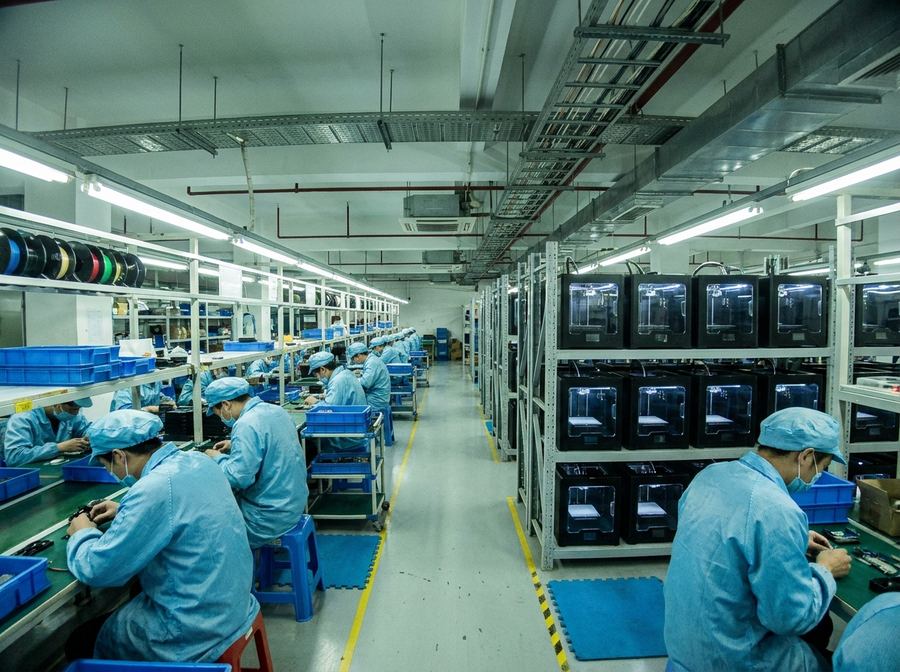
More than 50 printers run here as one cluster, giving roughly 30,000 print-hours of installed capacity a month. At that scale, tens or hundreds of functional parts start in parallel instead of queueing behind one machine, and a design that is still moving can be reprinted as often as it changes.
Print cluster and capacity
The machines are scheduled as one pool, grouped by part size and material, with long single parts and repeat batches kept apart so they do not compete for the same hours. An urgent job is split across several printers and post-processed together. Print parameters are fixed per material and part type in a process sheet, so the same file printed next month comes out at the same dimensions and the same strength as the batch before it.
Common materials
- PLA: dimensionally accurate and cheap, but it softens around 55 °C and creeps under sustained load — appearance and fit checks only
- PETG: tougher and more weather resistant than PLA, for functional parts carrying a real load
- ABS: better temperature resistance, sands and bonds well, for enclosures that need finishing
- Glass-filled: high stiffness and low deflection under load, for fixtures and support structures
- Carbon-filled: light and stiff, for end effectors, moving parts and weight-sensitive structures
What 3D printing is good for
The most common use is structural verification: whether the mechanism assembles, how a button feels, whether the cable route has room. A printed part in your hand answers that faster than any render. Next is enclosure prototyping, trial-fitted against the actual board. Then jigs and fixtures, where geometry is complex and quantity is low. Low-volume functional parts with a settled shape can be shipped as they are.
- Structural verification: interference, assembly sequence and cable routing, confirmed in hardware
- Enclosure prototypes: trial fit with the board, confirming cut-outs and snap positions
- Jigs and fixtures: locating blocks, stops, end effectors, simple check gauges
- Low-volume functional parts: shape settled, quantity not yet enough to justify a mould
When 3D printing is the wrong choice
Three processes, three different jobs. Choosing the wrong one rarely means the part cannot be made; it means money and weeks spent for nothing. What follows is a rule of thumb. The real answer depends on the load case and the quantity, so send the drawing and we will go through it with you before anything is quoted.
Use 3D printing when
Quantity runs from a few pieces to a few hundred, the geometry is complex, and the design is still changing. Or the part has internal cavities, lattices or undercuts that a cutter cannot reach. Or you simply need a physical object to check an assembly. In these cases printing is the cheapest route: the file goes on a machine as it stands, with no tooling to cut first, and a revision costs one more print rather than a new mould.
Use CNC when
The part has real tolerance requirements, mating faces, or threads that must carry load. Or the material has to be metal, or has to take heat. Z-axis strength in a printed part is well below that of solid stock, so a load applied across the layers will split it, and a change in load direction can crack a part that passed last week. Sealing faces, bearing bores and anything torqued repeatedly should be machined.
Use injection moulding when
Quantity runs to thousands, the shape is frozen, and unit cost decides the product. Tooling is a one-off investment that drops below print cost quickly once the volume is real, and surface finish and part-to-part consistency are better. The rough boundary: print while the design is still moving, mould once it is settled and the volume is there, and bridge the gap with CNC or low-volume printing.
| Item | Capability |
|---|---|
| Printers | More than 50 machines, scheduled as one pool |
| Installed capacity | Roughly 30,000 print-hours a month |
| Common materials | PLA, PETG, ABS, glass-filled, carbon-filled |
| Typical uses | Structural verification, enclosure prototypes, jigs and fixtures, low-volume functional parts |
| Related processes | CNC machining, laser cutting, electronics assembly, box build |
| Scheduling | Grouped by part size and material, urgent jobs split across machines |
| Telephone | +86 756 516 6177 |
For a quotation, send us your Gerber, BOM and pick-and-place files — we reply within one working day.