

Services
SERVICESContact Us
CONTACT USZHUHAI KAMEDA TECHNOLOGY CO., LTD.
Tel: +86 756 516 6177
Email: Show contact details
Add: 4/F, Block 4, No.26 XinKe 2nd Rd, Baijiao Science & Technology Industrial Park, Doumen District, Zhuhai, Guangdong, China 519100
+86 756 516 6177
Services
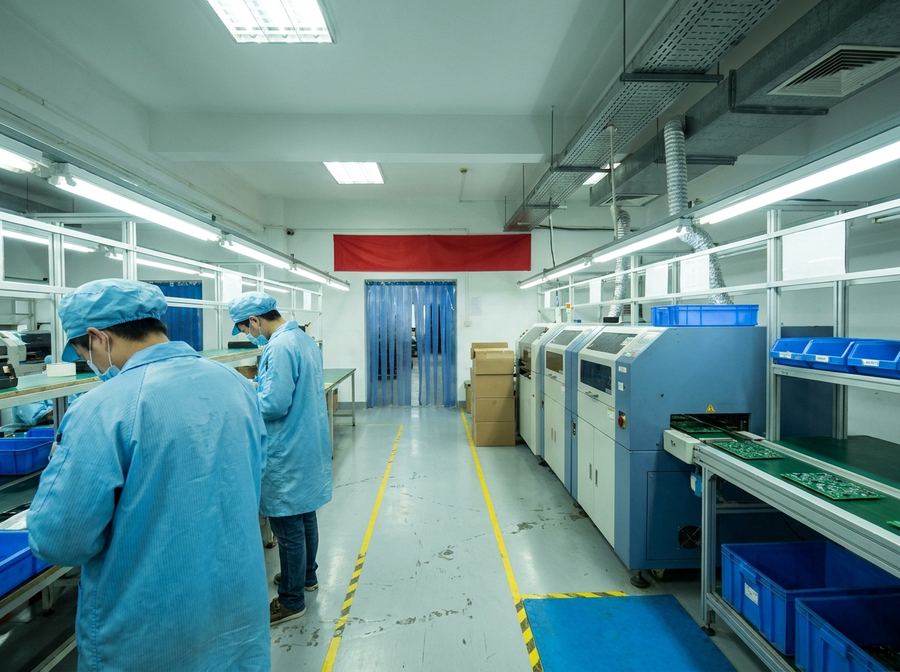
Kameda Technology has built electronics in Doumen District, Zhuhai since 2018. We take SMT assembly, through-hole (DIP) and secondary soldering, mixed-technology boards, turnkey PCBA and box build, in quantities from prototype through pilot run to volume production.
Placement, soldering, assembly and test happen in this building, so an engineering question is answered by the people who ran the board rather than relayed to a third party. Bare boards and surface finishing are bought locally — where a step goes outside, we tell you which step and to whom. Alongside PCBA we have electronic design, industrial robotics, 3D printing, CNC machining and laser work on site, so prototype boards and the parts they mount into can be made in parallel.
What we do
- SMT assembly: three lines, fine pitch, QFN and micro BGA, single- and double-sided placement. The smallest part placed is 01005 imperial (0402 metric), with 0201 imperial (0603 metric) as standard.
- Through-hole (DIP) and secondary soldering: wave soldering, selective soldering and hand soldering with locating fixtures, for boards heavy in connectors, transformers and high-power devices.
- Turnkey PCBA: component purchasing against your BOM. Turnkey, partial turnkey and consigned (customer-supplied) material are all accepted.
- Box build and test: final assembly, cable and mechanical assembly, functional test, burn-in, packing and outgoing inspection.
- Electronic design: schematic design, PCB layout, firmware and SDK work, with DFM, DFT and DFR review.
- Automation and robotics: more than 100 industrial robots in operation in the plant, and SCARA work cells built to requirement.
- 3D printing and rapid prototyping: more than 50 printers, giving roughly 30,000 print-hours of installed capacity a month.
- CNC machining and laser work: CNC machining, laser cutting and laser welding for prototypes, fixtures and enclosure parts.
How we work
Engagement is defined by who carries the material. Under turnkey we buy the bare board and every component against your BOM; under partial turnkey you supply the devices you already buy well or must specify, and we buy the rest; under consigned assembly you ship a complete kit, and we count it in, build it and reconcile what is left over. The process, the inspection standard and the records are identical in all three, so the choice follows your own purchasing position rather than ours. What each side supplies under each model is set out line by line on the Turnkey PCBA page.
From prototype to production
Send Gerber files, a BOM with manufacturer part numbers and the pick-and-place file. State the quantity, board material, layer count and surface finish, whether the job is turnkey, partial turnkey or consigned, the test level you want (AOI only, plus ICT or flying probe, plus FCT), the IPC-A-610 acceptance class the board is built to, and whether you need tin-lead rather than our standard SAC305. With that you get a quotation within one working day. If something is missing we list exactly what we need rather than quote a guess.
Once the quotation is accepted the file set goes to engineering review. The BOM is checked line by line against the layout for reference designators, footprints, values and quantities, and parts that are obsolete, single-sourced or long-lead are flagged. The DFM check covers pad design, apertures, panelisation, tooling rails, fiducials and spacing, and comes back as one list rather than in instalments.
After the process is agreed we order material, cut the stencil, write the placement program and build the prototype. First article inspection covers orientation, polarity, joint formation and test results before the rest of the batch is placed. First articles can be shipped to you for approval.
A pilot run follows first article approval. It exists to prove the reflow profile, the fixtures and the test program at line speed. Parameters are frozen at the end of the pilot run, and only then does volume production start.
Volume production travels with a work order signed off at each station. Material stays traceable by batch. Finished boards are inspected, packed and shipped with their inspection records. Defects found in production are logged by reference designator and batch, so a repeat order of the same board starts from what was learned on the first one.
For a quotation, send us your Gerber, BOM and pick-and-place files — we reply within one working day.