

Contact Us
CONTACT USZHUHAI KAMEDA TECHNOLOGY CO., LTD.
Tel: +86 756 516 6177
Email: Show contact details
Add: 4/F, Block 4, No.26 XinKe 2nd Rd, Baijiao Science & Technology Industrial Park, Doumen District, Zhuhai, Guangdong, China 519100
+86 756 516 6177
Production Equipment
Three SMT lines with a combined rated placement capacity of 500,000 components per hour. Solder paste printing, placement, reflow, through-hole (DIP) insertion, hand soldering, conformal coating, burn-in, final assembly and test all happen in this building. Bare boards and surface finishing are bought locally — where a step goes outside, we tell you which step and to whom. CNC machining, laser cutting and welding, and a 3D printing cluster run alongside the electronics lines and produce enclosures, brackets, test fixtures and assembly jigs.
Equipment on its own does not make a good board. Programs, fixtures and operators do. We start DFM review when the job is quoted, set process parameters against the laminate, the component packages and the solder paste in use, and tune the reflow profile, stencil apertures and placement program during the prototype build. Production then runs to the parameters that were signed off, which is what keeps batch-to-batch variation down.
-
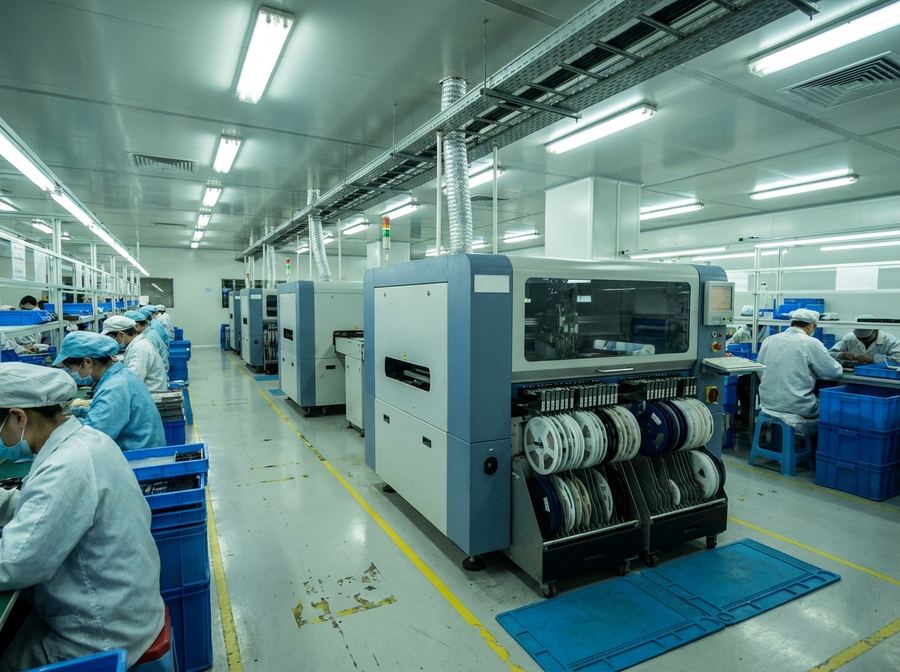
High-speed placement
-
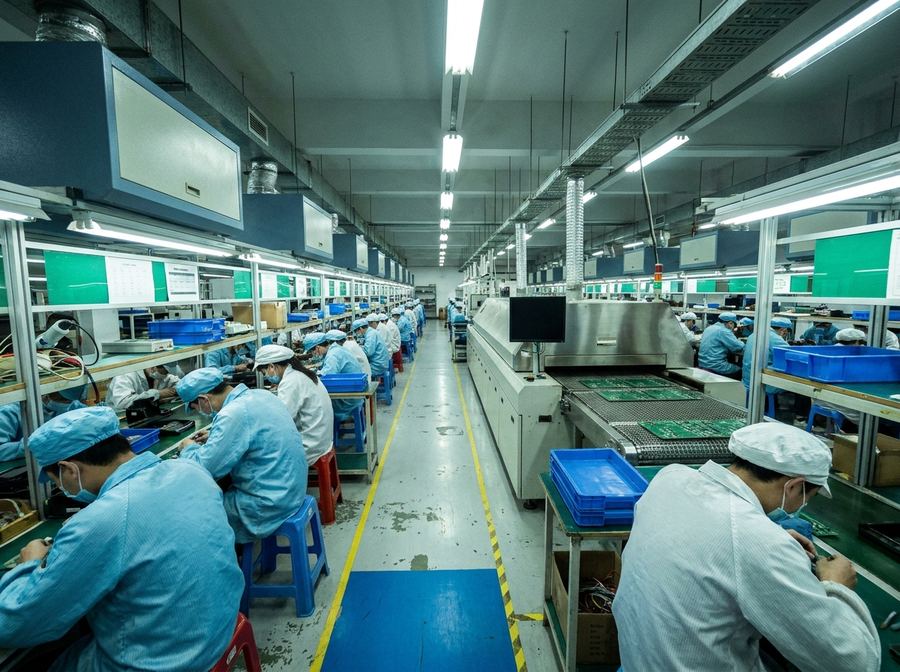
Multi-zone reflow
-
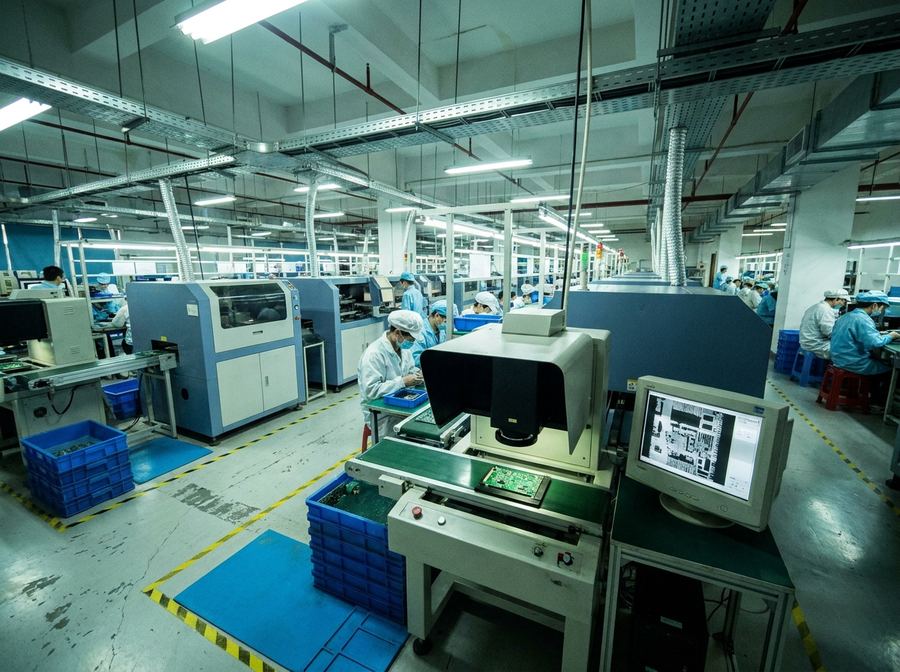
AOI inspection
-
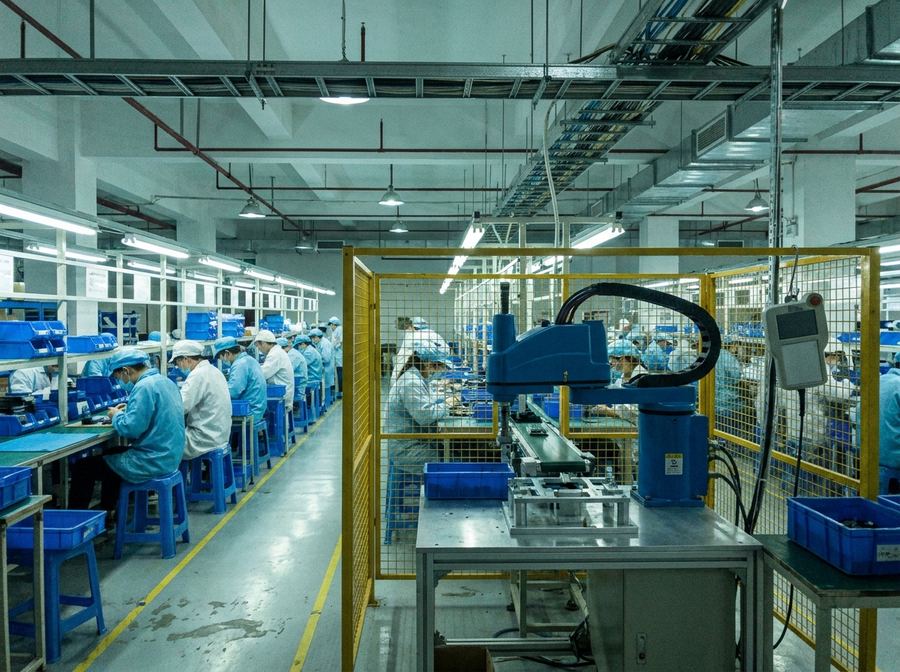
Robot work cells
-
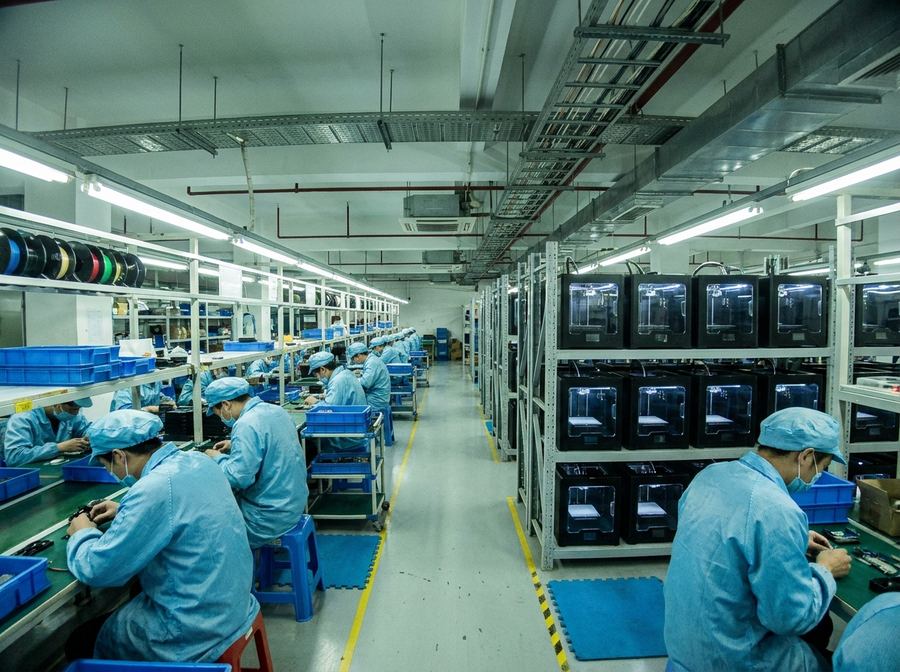
3D printing cluster
-
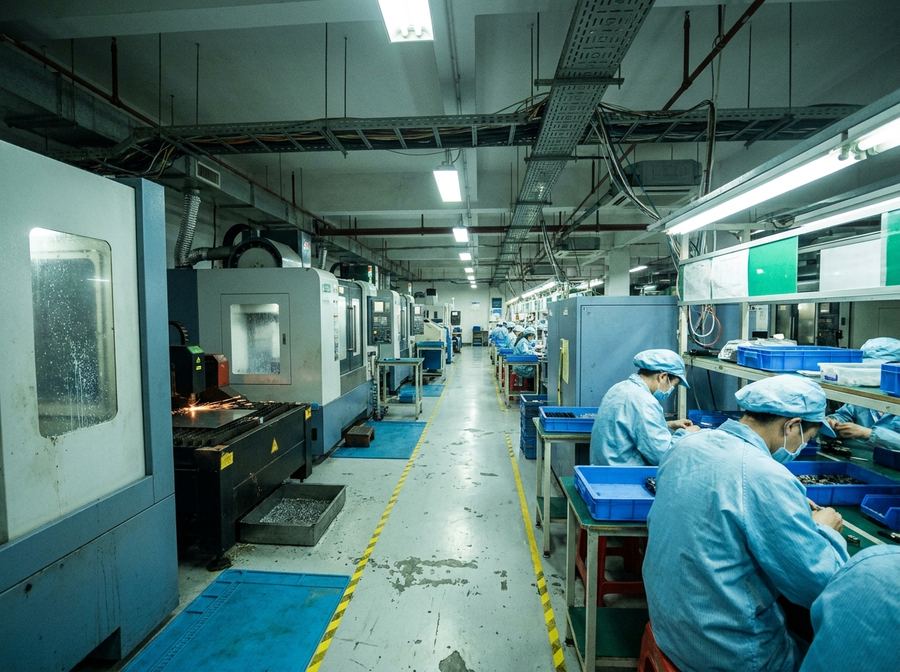
CNC and laser
Equipment and capability
| Equipment / process | Capability |
|---|---|
| Stencil printing and SPI | Automatic printers with laser-cut stainless stencils, nano-coated. SPI measures paste height, area and offset after printing, which catches insufficient paste, bridging and skew before any component is placed |
| High-speed placement | Our SMT lines place down to 01005 imperial (0402 metric), with 0201 imperial (0603 metric) as standard, and handle fine pitch and micro BGA |
| Reflow | Multi-zone reflow ovens. Profiles are set against laminate, paste and component thermal mass, measured on the board with a profiler before production and kept on file. SAC305 lead-free as standard; tin-lead where you specify it |
| Wave and selective soldering | Wave soldering for volume through-hole work. Selective soldering and hand soldering for odd-form parts, dense pin fields and joints next to heat-sensitive components |
| AOI | Pre-reflow and post-reflow stations. Pre-reflow catches wrong part, missing part, offset and reversed polarity while rework is only a re-place. Post-reflow catches tombstoning, bridging, insufficient solder, solder balls and poor joint formation |
| X-ray | Sees the joints hidden under BGA, QFN and LGA packages: voiding, bridging, open joints and offset. Mandatory on first article, sampled in production, and repeated after any BGA rework |
| ICT | Bed-of-nails fixture measures resistors, capacitors, diodes and transistors node by node for opens, shorts, wrong part and out-of-tolerance values. The fixture takes time and money to build, the test cycle is seconds, so it pays off on stable designs in volume |
| Flying probe | Probes travel to coordinates from the CAD data, no bed-of-nails fixture required. A design change means a program change. Slower per board, which makes it the right choice for prototypes, small runs and pre-production verification |
| FCT | Functional test on a powered board, using a fixture and test program supplied by you or developed here. Simulates the real operating condition and verifies board-level function and key parameters |
| BGA rework | BGA rework stations and IR rework. Removal, site cleaning, reballing and re-placement, followed by X-ray |
| Conformal coating | Selective and manual coating, with masking to your drawing before coating. For products that will see humidity, salt fog or dust. Name the coating material and the thickness you want in the specification |
| Burn-in | Powered burn-in at the temperature, duration and load you specify, to bring out early-life failures before shipment |
| CNC machining | CNC machining centres for enclosures and structural parts, and for test fixtures and assembly jigs |
| Laser cutting and welding | Laser cutting and laser welding for sheet metal and metal structural parts |
| 3D printing | More than 50 printers, giving roughly 30,000 print-hours of installed capacity a month. Used for prototype parts, fixtures and low-volume structural components |
| SCARA work cells | Dispensing, screw driving, pick-and-place and assembly steps that repeat. More than 100 industrial robots in operation across the plant |
| Manual assembly | Manual assembly line and box build, supporting NPI, visual inspection, labelling and packing |
Shop floor environment
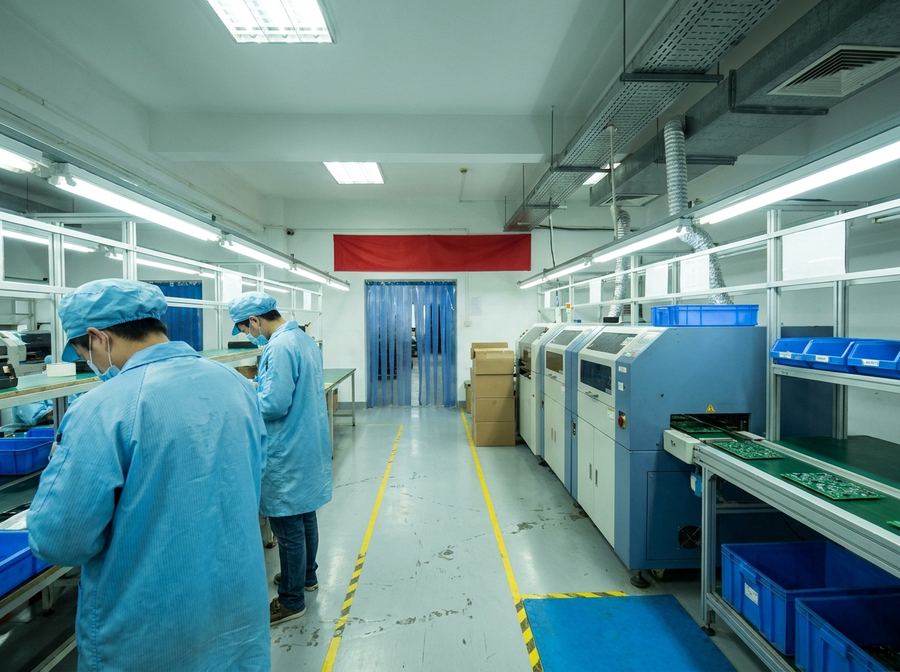
The SMT floor is temperature and humidity controlled, with readings logged on a fixed interval and kept on record. ESD control applies throughout: smocks and ESD footwear to enter, wrist straps on operators, ESD bench mats bonded to ground. Wrist straps and mats are checked at the start of every shift and replaced immediately if they fail the check.
The floor is zoned by function. Printing and placement, soldering, inspection, through-hole and hand soldering, and assembly and packing are separate areas, linked by transfer trolleys and travellers so material does not get mixed or cross between jobs. Material is issued first in, first out. Moisture-sensitive devices are stored in dry cabinets by MSL with exposure time recorded, and anything past its floor life is re-baked before it goes back on the line.
For a quotation, send us your Gerber, BOM and pick-and-place files — we reply within one working day.